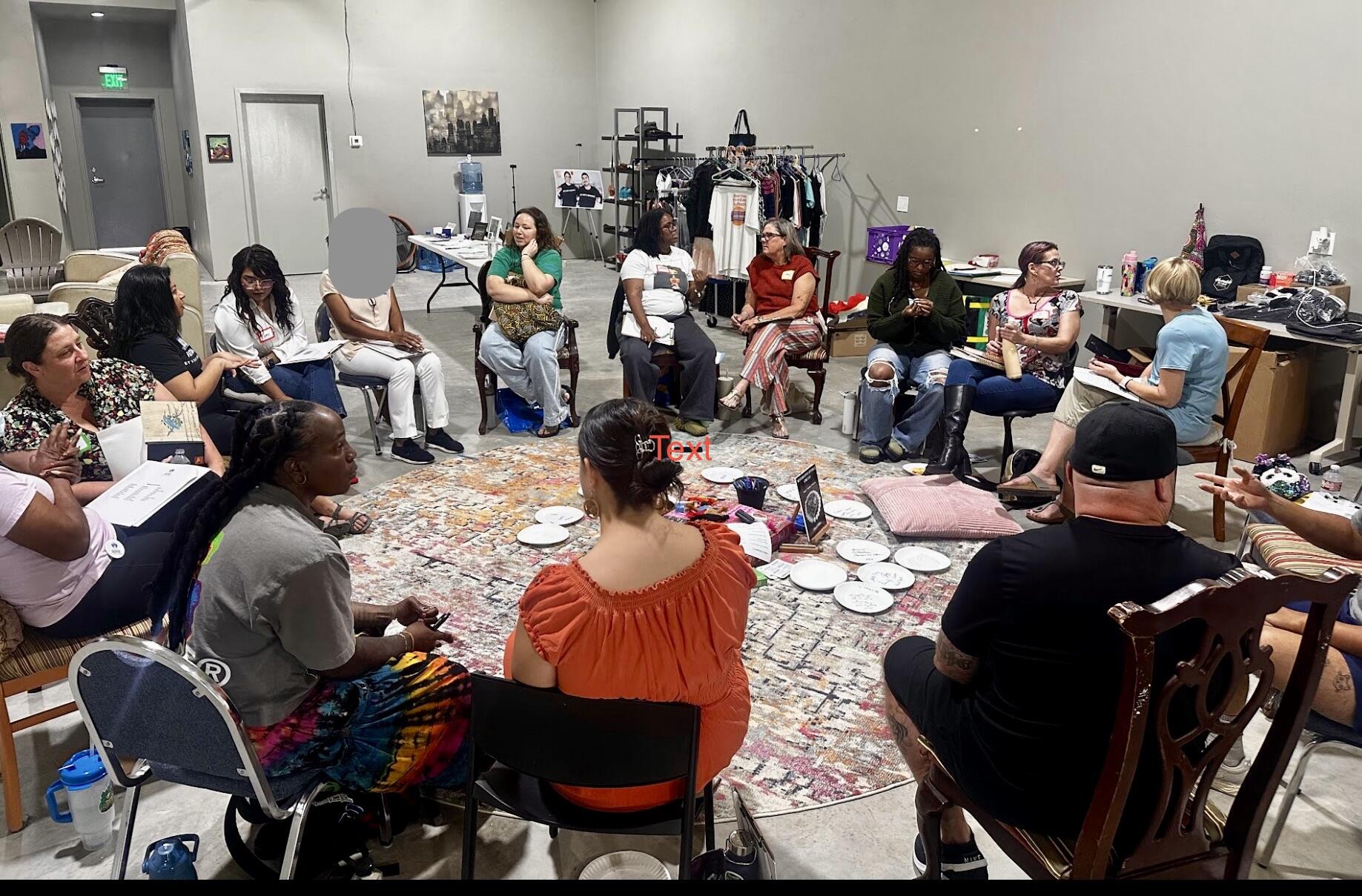
Last week we had the opportunity to partner with T.E.J.A.S (Texas Environmental Justice Advocacy Services) to keep a Circle!

Students and parents gathered at the T.E.J.A.S. (Texas, environmental justice, advocacy services) office for a Community Voices for Public Education sick out to protest the takeover of the Houston Independent School District by an unelected superintendent and school board. Young people were invited to participate in meaningful activities in place of attending school.
At T.E.J.A.S. and CVPE’s invitation, we had the honor of facilitating a restorative circle with the youth. Youth board member Amiyah Yates led a powerful conversation centered on the importance of speaking up for yourself and using your voice. It was a beautiful opportunity for our youth circle keeper to connect with the next generation and hold space for dialogue around issues that matter to them.
We are deeply grateful to the entire @tejashtx and @houstoncvpe team for the opportunity to partner during such an important community moment.
We had a beautiful grief circle!

Already community members have reached out with requests for grief circles as we witness students being criminalized for protesting, and most recently learned of a student seeking asylum facing deportation.
Together, we listened to two songs about immigration, wrote down what was weighing on our hearts, and then tore those words up and placed them into a collective space. It allowed us to release, to be present, and to hold one another with care. Please reach out if you want spaces such as these in your homes, workplace, or community
Ucoming Events:


This month’s Youth Circle has been cancelled, but stay tuned for next month!


Decolonization Corner
🌱 Accountability Over Punishment
Many of us were raised to believe that when harm happens, punishment is the answer. Someone breaks a rule, and the solution is exclusion, shame, or consequences imposed from the outside. But punishment is largely passive. It does not require growth, reflection, or repair from the person who caused harm. It often asks only that they endure the consequence.
Decolonizing Restorative Justice means shifting from punishment to accountability.
Accountability is active. It requires participation. It asks something of us.
True accountability includes:
Understanding how our behavior impacted others
Acknowledging that our behavior was a choice — and that we could have chosen differently
Naming directly to those impacted that our actions caused harm
Taking steps to repair that harm where possible, ideally in a way defined by those harmed
Making meaningful changes so we do not repeat the same behavior
This process is not about humiliation or self-condemnation. It is about dignity. It recognizes that we are capable of making harmful choices — and also capable of repair and transformation.
Colonial systems rely on punishment because punishment maintains control. Restorative frameworks rely on accountability because accountability builds stronger, more conscious community.
When we practice accountability, we interrupt cycles of blame and defensiveness. We create space for growth. We strengthen trust. And we move closer to the kind of communities many of our ancestors understood — ones rooted in responsibility, relationship, and repair.
Reflection Prompt:
Where in your life have you experienced punishment instead of accountability — and how might things have been different if repair had been centered?
🔗 Learning & Resources
✨ Why Decolonization Belongs in Restorative Justice Work
At Restorative Houston, we understand restorative justice as a decolonial practice. Before courts, prisons, and punishment-based systems, many Indigenous communities addressed harm through relationship, accountability, repair, and collective care.
Colonization disrupted these systems by replacing community-based responses to harm with systems rooted in control, punishment, and separation.
Decolonization, in this sense, is about remembering and restoring ways of being that center healing over harm, relationship over domination, and accountability over punishment.
Decolonization Corner exists to help us unlearn the dominant worldview that shaped modern justice systems and to reconnect with the kinship-based values that restorative justice is grounded in.
Each edition of Decolonization Corner invites readers to explore how decolonial thinking supports restorative justice—both internally and collectively.